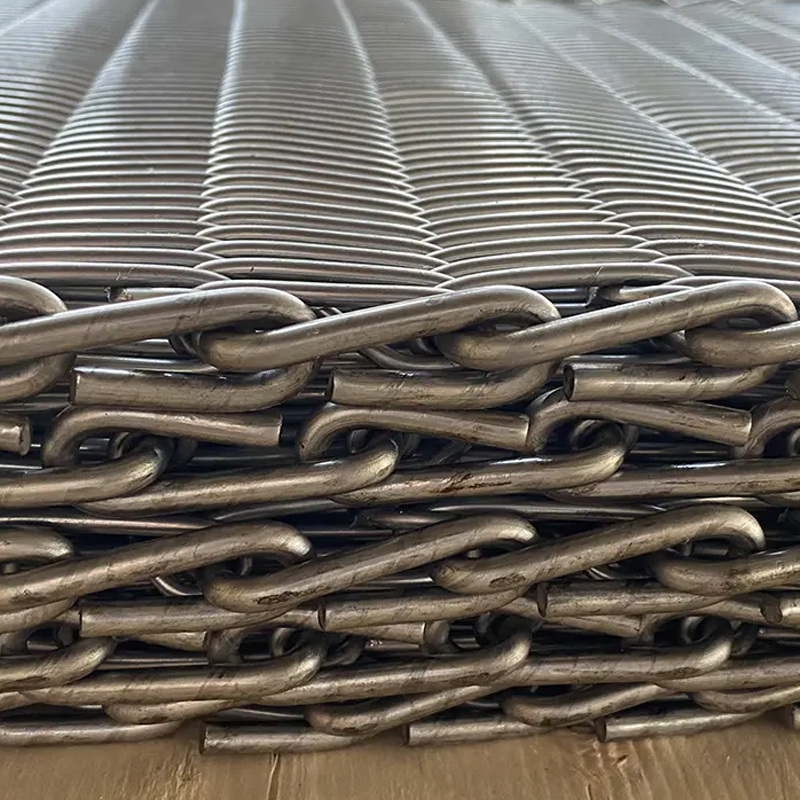
A powder metallurgy plant replaced the same furnace belt four times in two years. The alloy on the purchase order was correct every time: 304 first, then 316, then 314. The belt still failed. The cause was a 12 mm edge mismatch that let the belt drift into the guide rail, abrade a single strand, and unravel from there. Stainless steel mesh belts rarely fail because someone picked the wrong grade. They fail because the grade, the weave, the edge, and the drive were specified one at a time instead of as one system.
What a Stainless Steel Mesh Belt Actually Is
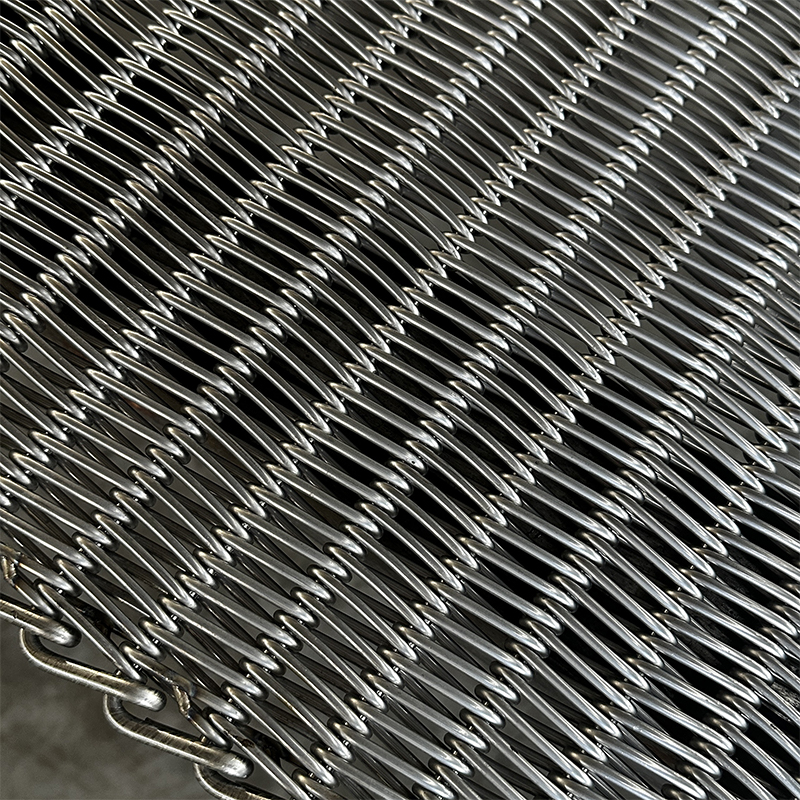
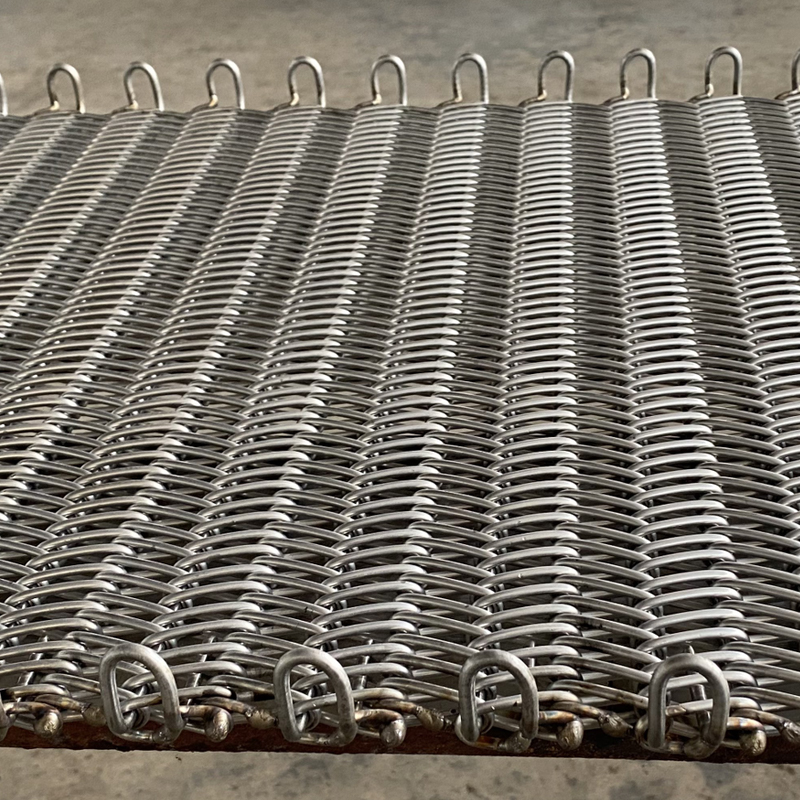
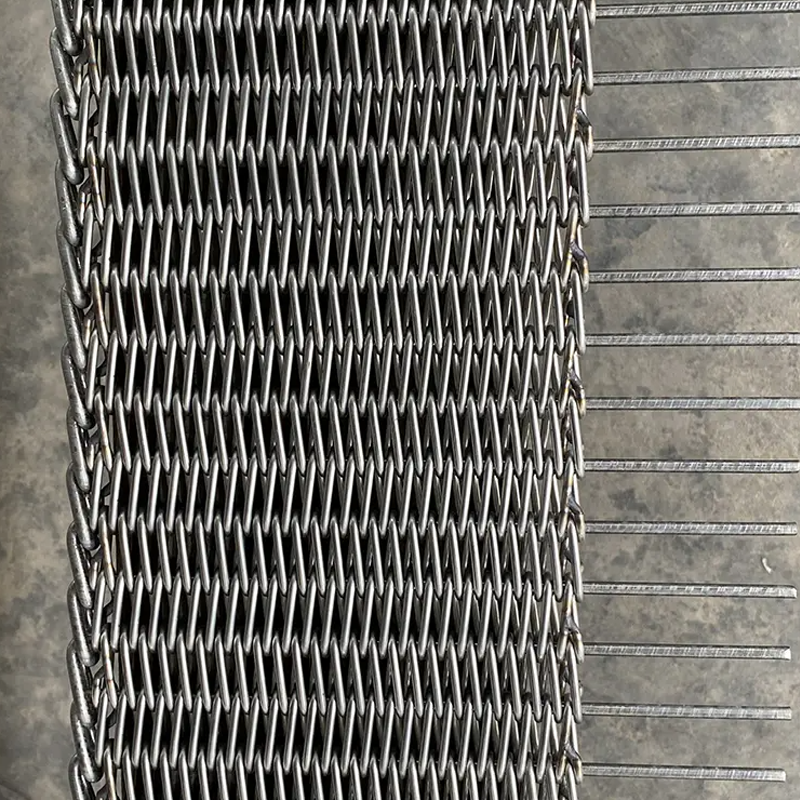
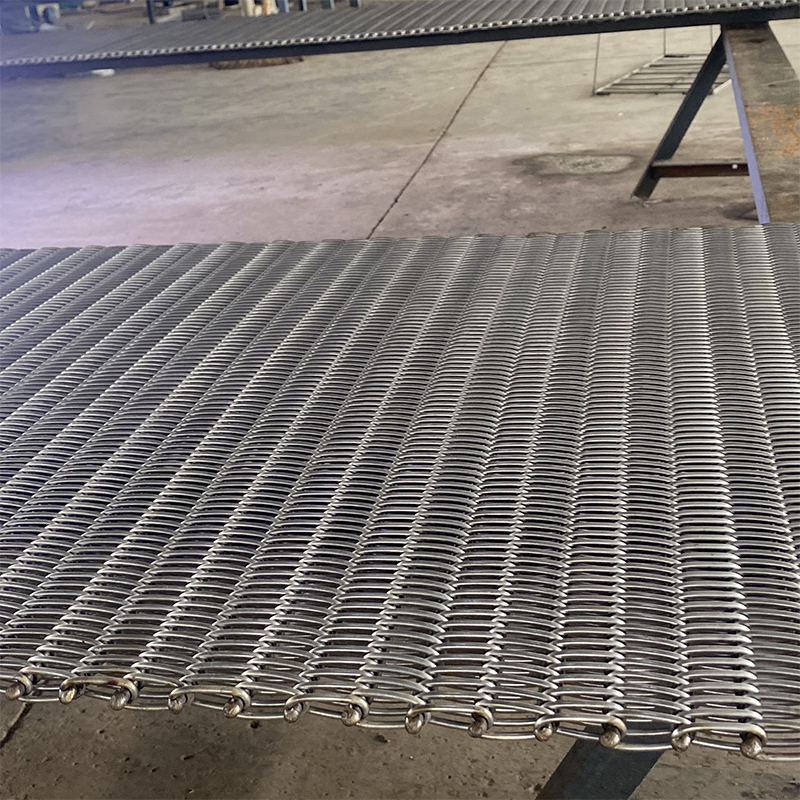
A stainless steel mesh belt is an assembly, not a fabric. Every belt combines a carrying surface of spiral or woven wire, cross rods that lock the spirals at a fixed pitch, an edge treatment that survives the drive, and a tracking arrangement that keeps the belt centred on the line. The same product is sold as a conveyor mesh belt, a furnace belt, or a wire belt; those labels describe one component family.
Constructions worth knowing
- Balanced weave: alternating left-hand and right-hand spirals joined by crimped cross rods, the general-purpose choice.
- Rod-reinforced weave: extra straight rods raise stiffness and cut sag under heavier loads.
- Chain edge: side chains carry tension and drive forces, so the mesh surface only carries product.
- Chain-plate edge: shaped plates at the selvage resist lateral creep on wide belts.
- Elevator or hoist belt: flights or buckets built into the belt for vertical transport.
Three dimensions decide most of the performance: spiral pitch, wire diameter, and cross rod diameter and spacing. Pitch sets open area and the smallest part the belt can carry without a support plate. Wire diameter sets tensile strength and heat capacity. Cross rod spacing sets how far the surface deflects between supports.
Start With the Process, Then Pick the Belt
The furnace or the freezer decides the product family. A sintering line needs different geometry from a quench line, and a brazing line needs different geometry again. Work down the tree before you look at a catalogue number.
- Sintering furnaces
- Powder metallurgy parts: copper-based, iron-based, stainless-based
- Electronic components and circuit boards
- Ceramic components, filters, resonators, sensors
- Foamed nickel and solar photovoltaic cells
- Heat treatment furnaces
- Quenching, tempering, normalizing, annealing
- Bright annealing and brightening
- Blackening and forging
- Elevator belts for vertical transfer
- Brazing furnaces
- Aluminium: water tanks, condensers, evaporators
- Copper: accumulators, automotive pipe, valves, heating elements
- Stainless steel: air-conditioning lines, heat exchanger cores, medical devices
- Food and general conveying
- Drying, quick freezing, assembly-line conveying
- Chain mesh belts for continuous heating and transmission duty
Inside a family, four inputs settle the geometry: peak and average temperature, furnace atmosphere, product weight per square metre, and the way the belt is driven. A sintering belt carrying dense steel compacts at 1120 °C is a different belt from one carrying 3 g electronic parts at the same temperature, even though both belong to the same furnace class.
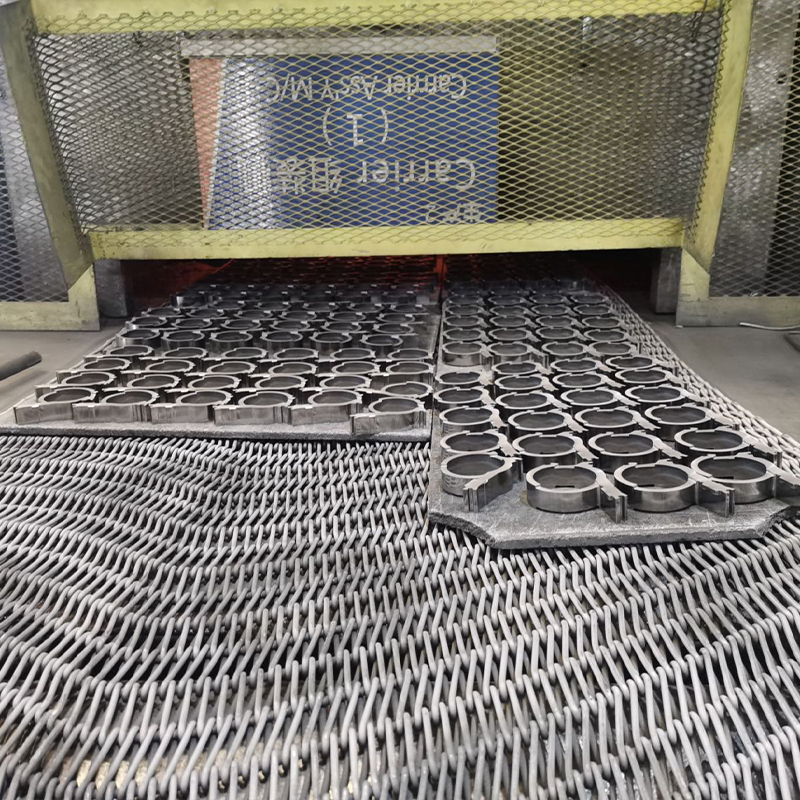 Powder Metallurgy Sintering Furnace Mesh Belt CategoryContinuous sintering furnace mesh belts for pressed powder metallurgy parts, typically AISI 314 with thick wire and hooked edges suited to production lines.View Product →
Brazing is the tightest case. Aluminium brazing runs close to the filler melting range, so flatness and edge alignment matter as much as heat resistance; a belt that tracks badly drops a condenser core onto the hood. Copper and stainless brazing belts follow the same logic, with the extra requirement that the surface must not mark the joint area.
Alloy Grade, Temperature Headroom, and Atmosphere
Grade selection follows one rule: never run a belt at its published ceiling. Continuous service limits assume clean air, light loading, and steady temperature. Real furnaces add thermal cycling, product load, and an atmosphere that is often not air. A 304 belt rated near 900 °C in air will fail early in hydrogen or cracked ammonia at the same temperature, because the protective oxide layer never forms and chromium is consumed from the surface.
Figure 1: typical maximum continuous service temperatures for common belt alloys in air. Every value falls with load, cycling frequency, and aggressive atmospheres, so confirm the real limit against your furnace data rather than a datasheet headline.
Choosing between grades
- 304: economical default for oxidizing furnaces up to about 900 °C and for food conveying.
- 316: lower temperature ceiling but far better resistance to chlorides and washdown chemicals.
- 309S and 310S: higher nickel and chromium for 1000 to 1100 °C service and repeated cycling.
- 314: the strongest resistance to scaling and carburizing atmospheres where 310S scales too quickly.
- 321: titanium-stabilised, useful where intergranular corrosion near welds is a risk.
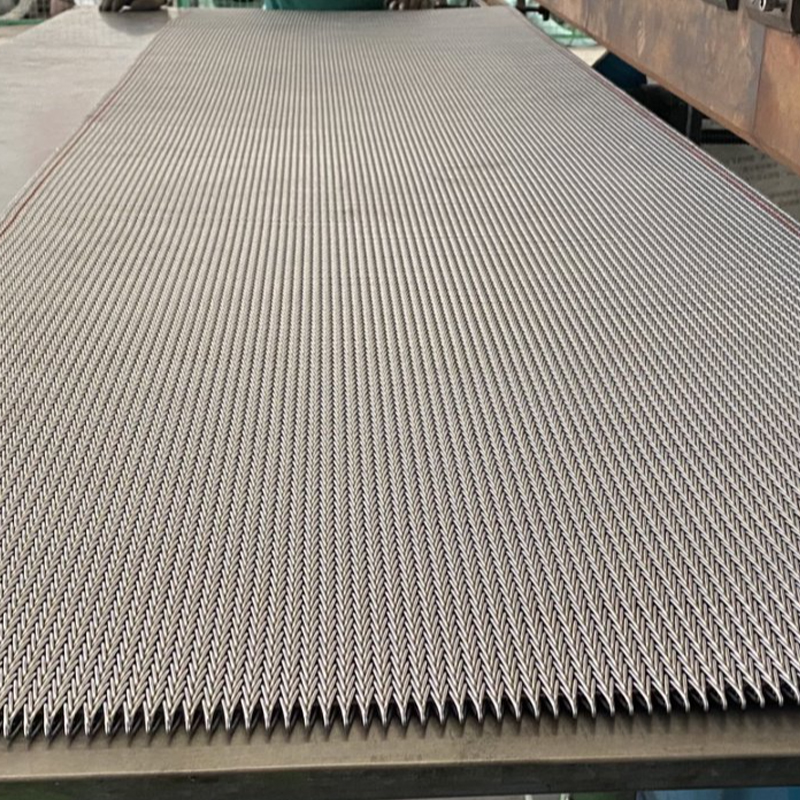 Quenching Furnace Mesh Belt for Heat TreatmentHeat-resistant conveyor belt for continuous hardening and quenching lines; herringbone weave and folded edges help handle fasteners, springs, and bearings.View Product →
Two habits extend life more than an upgrade in grade. Keep the belt moving through the hot zone at constant speed so no section soaks longer than the rest, and allow enough take-up travel for thermal expansion. A belt that goes slack when hot climbs the sprocket and wears its edge within weeks.
The Specification Checklist Before You Order
Most belt failures trace back to a number missing from the enquiry, not to a manufacturing defect. These values should be settled before a quote is issued.
Table 1: The values that decide whether a mesh belt fits a line. A mismatch in any single row usually shows up as edge wear or uneven stretch within weeks.
| Value |
Why it matters |
Common mistake |
| Belt width |
Must match the driven shaft and the guide-rail gap |
Ordering nominal width without side clearance |
| Spiral pitch |
Sets open area and the smallest part the belt supports |
Closing pitch for airflow and adding belt mass |
| Wire and rod diameter |
Determines tensile strength, sag, and heat capacity |
Upsizing wire and overloading the drive |
| Edge type |
Carries drive and tension forces |
Specifying a plain selvage on a heavy, wide belt |
| Load per square metre |
Sets belt life more than temperature does |
Quoting load in kg per metre instead of per square metre |
| Sprocket detail |
Belt pitch must match tooth geometry |
Replacing a belt without measuring sprocket wear |
| Temperature and atmosphere |
Picks the alloy and any post-weld treatment |
Using an air rating inside a hydrogen atmosphere |
| Take-up travel |
Absorbs thermal expansion |
Leaving too little travel, so the belt goes slack hot |
| Product contact |
Prevents marking and contamination |
Overlooking hygiene rules on food or medical lines |
Tracking, Tension, and the Failures That Cost the Most
A mesh belt is a wear part, and its life depends as much on installation as on manufacture. Five failure modes cover most unplanned stoppages.
- Edge strand breakage, usually guide-rail abrasion from insufficient side clearance or a misaligned rail.
- Rod wear at the sprocket, where a worn tooth changes effective pitch and loads the rods unevenly.
- Uneven elongation, where one side runs hotter or tighter until the belt snakes and cannot be tracked back.
- Thermal fatigue cracking, made worse by over-tensioning a belt cold.
- Product marking, caused by too small an open area or a rough rod surface on soft parts.
Re-tension after the first 40 hours, then inspect weekly. Record stretch as a percentage of the original length; once elongation nears 2 per cent, the belt is close to the limit of its tracking range and should be scheduled for replacement instead of adjusted again.
Food, Freezing, and Non-Furnace Conveying
Not every stainless steel mesh belt runs in a furnace. Quick-freezing tunnels run at -35 to -40 °C and drying lines at 60 to 120 °C, and both need open area for airflow, a surface that does not trap food particles, and materials that survive daily washdown. That last point decides the grade, because cleaning chemicals carry chlorides and chlorides attack 304 far faster than 316. Hygienic design matters too: welded edges, no crevices at the cross rods, and no hollow sections holding water. Food processing mesh belts are usually specified with tighter pitch and lighter wire than furnace belts, because load is low and airflow, not strength, sets performance.
What to Send for a Quote That Holds Up
A supplier can only guarantee a belt against the data you provide. Send all of the following in one message.
- Belt width, overall length, and edge type, or a photograph of the failed belt on the line.
- Drive detail: tooth count, pitch, shaft diameter, and current sprocket wear.
- Peak and average temperature, plus the atmosphere: air, nitrogen, hydrogen, endothermic, or exothermic.
- Product weight per square metre and how it is distributed across the width.
- Cleaning method, chemicals, and whether washdown water reaches the belt.
- The failure you are trying to fix, with belt age at failure.
The last item is the one buyers skip. "The belt broke" is not a specification. "The belt stretched 3 per cent in six months and started tracking left at 850 °C" tells a supplier which of the values above to change. If you are weighing options inside a heat treatment line, how to choose the right heat treatment mesh belt follows the same sequence from the furnace side.



 English
 русский
 عربى
عربى